Design the Technology That Powers Everything
Microchips are everywhere. They're in your smartphone, your car, the satellites overhead, the medical devices saving lives, and the AI systems reshaping our world. Every major technological breakthrough—from autonomous vehicles to quantum computing—starts with a chip. And Europe needs you to design them.
The Intelligent Chips and Systems Master's programme puts you at the heart of the semiconductor revolution. Study across two leading European universities, master both hardware and software design, and gain the entrepreneurial skills to transform ideas into innovation. In two years, you'll go from student to the kind of engineer that Europe's tech sovereignty depends on.
This is your chance to shape the future—one chip at a time.
Why Intelligent Chips and Systems?
The World Runs on Chips. Will You Design Them?
Microelectronics engineers are the architects of the modern world. The chips you'll learn to design don't just power devices—they enable breakthroughs:
- Healthcare: Implantable devices monitoring heart health in real-time, AI-powered diagnostics running on edge processors
- Mobility: Self-driving cars processing millions of data points per second to keep passengers safe
- Sustainability: Energy-efficient chips reducing global power consumption and enabling smart grids
- Security: Hardware-level encryption protecting everything from banking to critical infrastructure
- Space Exploration: Radiation-hardened processors exploring Mars and beyond
- AI Revolution: Specialized chips accelerating machine learning and making AI accessible everywhere
The global semiconductor market is projected to reach €1 trillion by 2030, with Europe investing €43 billion to double its global market share. The demand for chip designers has never been higher, and it's only growing.
Your expertise won't just be valuable. It will be essential.
Your Career: Unlimited Possibilities
From Graduate to Game-Changer
Microelectronics engineers are among the most sought-after professionals in tech. With this double-degree master's, you'll unlock career paths that most engineers can only dream of:
Join Industry Giants
- Design cutting-edge processors at ASML, STMicroelectronics, Intel, TSMC, Samsung
- Work on next-generation communication systems at Nokia, Ericsson, Qualcomm
- Develop breakthrough technologies at Airbus, European Space Agency, Philips
- Shape the future of AI hardware at NVIDIA, Google, Amazon
Pioneer Research & Innovation
- Lead research at world-class institutes like imec, Fraunhofer, CEA-Leti
- Pursue a PhD and publish groundbreaking work in chip architecture
- Collaborate with universities on the next generation of quantum
Build Your Own Startup
- Launch a deep-tech company solving real-world problems with custom silicon
- Join the European startup ecosystem revolutionizing IoT, edge computing, or semiconductor IP
- Access EIT Digital's innovation network, funding, and mentorship
Average starting salary for microelectronics engineers in Europe: €45,000-65,000
Senior positions and specialized roles: €80,000-120,000+
Career at STMicroelectronics as Analog Design Engineer

What Makes This Programme Unique?
The Only Master's That Covers Everything—From Silicon to Software
Most programmes teach you either hardware or software. We teach you both. And then we add business skills on top.
Holistic Chip Design Education
- Year 1: Master the fundamentals —embedded systems, chip architecture, IoT, networking, and intelligent system design. Plus innovation and entrepreneurship training.
- Year 2: Specialize in your passion—from advanced chip design to AI hardware, robotics, or safety-critical systems. Complete a real-world design project and industry internship.
Double-Degree from Two European Universities
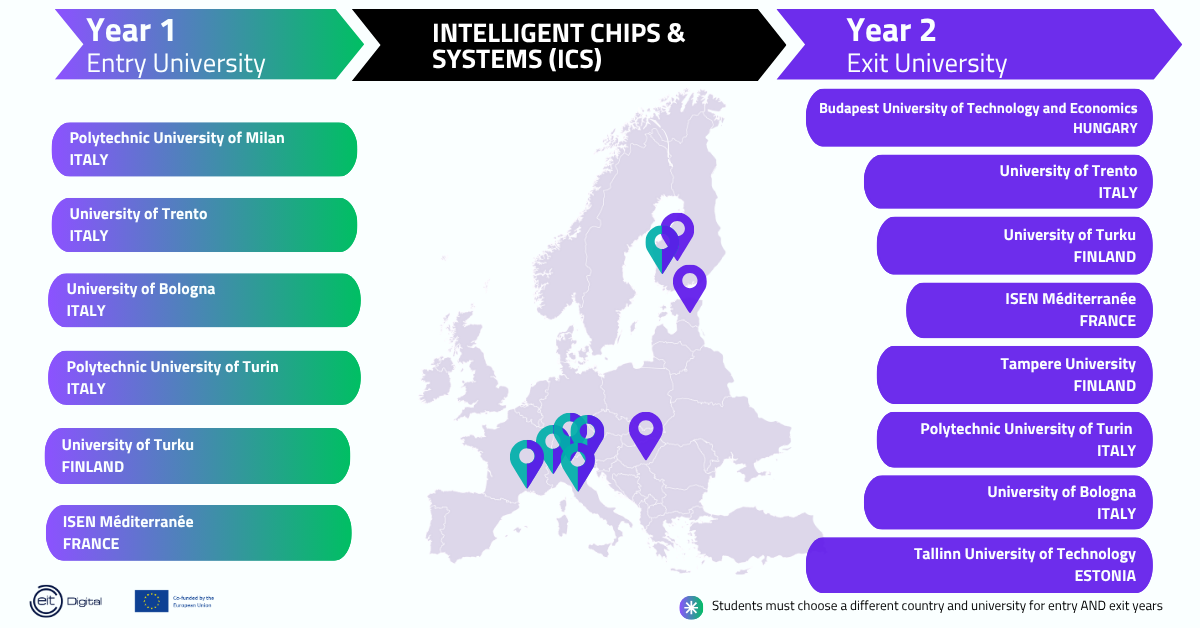
Study at two institutions from our network of 9 leading universities across 5 countries:
- University of Bologna (Italy)
- Polytechnic University of Milan (Italy)
- Polytechnic University of Turin (Italy)
- ISEN Méditerranée (France)
- Budapest University of Technology (Hungary)
- Tallinn University of Technology (Estonia)
- Tampere University (Finland)
- University of Turku (Finland)
- University of Trento (Italy)
Industry-Embedded Learning
- Backed by SEMI Europe (the global semiconductor industry association)
- Developed with STMicroelectronics (a €12 billion global leader)
- 6-month internship at top companies or research labs
- Real design projects solving actual industry challenges
Innovation & Entrepreneurship Minor
Don't just be an engineer—be an innovator. Learn to turn technical expertise into business impact, pitch to investors, and understand the market dynamics shaping the semiconductor industry.
EU-Funded Excellence
Part of the RESCHIP4EU initiative supported by the EU's Digital Europe Programme, reinforcing Europe's position in the global semiconductor race.
Where can I study Intelligent Chips and Systems?
Who Should Apply?
If You're Ready to Go Deep, This Is For You
You're the right fit if you have:
- A Bachelor's degree (or final year) in Computer Science, Electrical Engineering, Computer Engineering, Software Engineering, Mechatronics, Mathematics, or related fields
- At least 40 ECTS in ICT subjects (programming, computer architecture, digital systems)
- At least 20 ECTS in mathematics (calculus, algebra, statistics)
- The ambition to create technology, not just use it
Relevant professional experience may compensate for formal requirements—highlight it in your motivation letter.
Funding Your Future
Excellence Shouldn't Depend on Your Bank Account
EIT Digital Scholarships (EU nationals and associated countries):
- Scholarships of Excellence: Full tuition waiver + monthly living allowance
- Full Tuition Waivers: 100% of programme fees covered
- Half Tuition Waivers: 50% of programme fees covered
Additional funding options: University-specific scholarships, national grants, and EU financial aid programmes.
Apply for scholarships directly through the application portal.
The Semiconductor Talent Gap is Real
- Europe aims to double its global semiconductor market share by 2030
- Critical shortage of 150,000+ skilled microelectronics professionals in Europe
- Every major tech company is competing for chip design talent
- Starting salaries higher than most engineering disciplines
- Career longevity: Chip design skills remain relevant for decades
This isn't just a degree. It's a passport to the future of technology.
The programme is developed and delivered under European Union‘s Digital Europe Programme Project no. 101158828.